
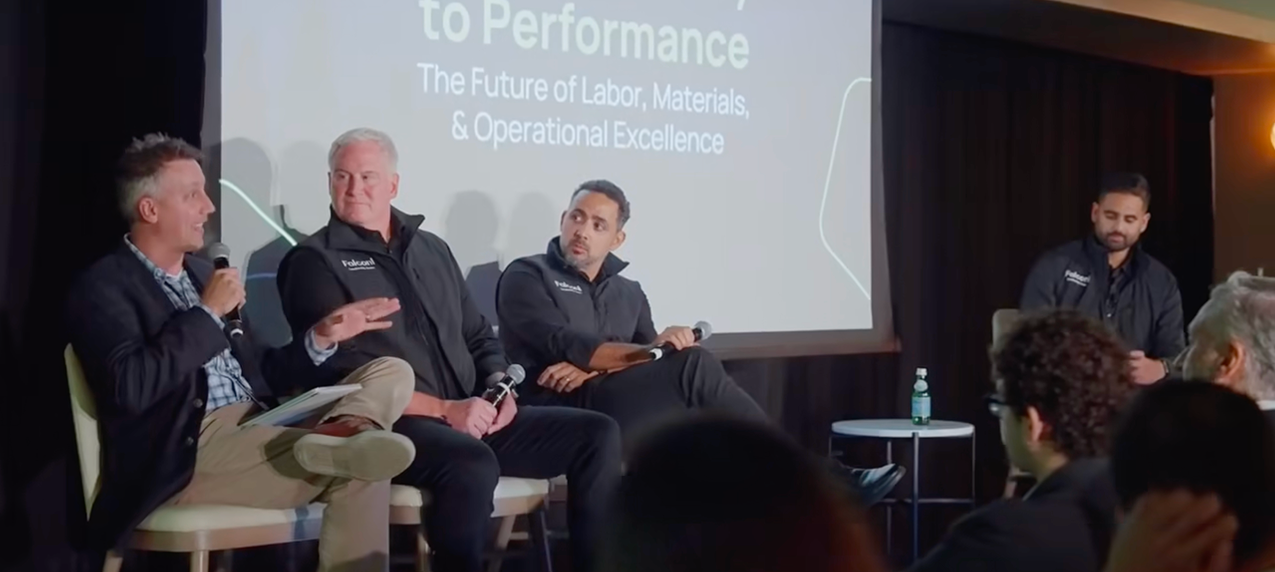

Near the end of the executive panel at Falconi Edge 2026, Falconi team member and moderator Veek Cheema tried to get the panelists to debate each other.
He asked, "If you were advising a manufacturing CEO who could make only one major improvement over the next three years, where would you tell them to invest: technology, workforce capability, or management systems?"
The panelists had every reason to disagree, at least on paper. Jeff Winters is a Vice President at Belden, which sells industrial networking and connectivity hardware. Vince Ambrosino is an operations leader with decades on factory floors and grocery shelves. And our own Gabriel Rodrigues is a Falconi partner who has spent his career helping plants implement management systems.
So it was kind of surprising when all three gave the same answer: management systems.
The rest of the panel explained why, and what it means for anyone running a manufacturing operation right now.
Why management systems won
Jeff started by making the case with numbers. He referenced a McKinsey study from this year that found 80% of individuals were more productive because of AI, but only 37% of their companies could find an actual ROI from it. He also called out another study from Microsoft and Harvard that found the same thing. The latter study argued that one major reason was the company didn't change how it approached the work - meetings stayed the same, team members weren't trained on what to do with all that newfound time, etc. <FIND CITATIONS>
Those studies both argue that it's not a technology thing or a capability thing. A better management system is necessary to make a bunch of individual gains translate to the corporate level.
Vince agreed, and added the other half of the argument. Anyone who's tried to layer tech on top of bad process knows how that movie ends. It's expensive, and slow, and nearly impossible to unwind. Similarly, without a rigorous work system, it's quite hard to tell who your capable people are, so you can't answer the workforce question either.
Gabriel did push back somewhat. He argued that while the management system is critical, you don't necessarily have to roll it out enterprise wide before tackling the other two elements. You can pick one part of your operation and work to move all 3 together in incremental steps. This gives you short term performance improvements and a model that can then scale to the rest of the company.
The most overhyped technology on the floor right now
The panel went into a number of other topics as well. Veek asked them to name one overhyped and one under-appreciated technology.
Jeff called out generic agentic AI. He said the tech itself is fine. But many companies aren't really ready to use it. He suggested thinking about AI adoption as moving along two different spectrums: intelligence and agency. Raising intelligence is pretty cheap now. But raising agency is a different animal. Agentic workflows involve making real decisions. Which can create tremendous risk if not done intelligently. Before you raise agency, three things have to be true:
- You've decided which decisions are eligible for delegation. Not every decision should be.
- Every AI decision needs to have an owner, for risk, performance, and escalation. Skip this and you accumulate what Jeff calls decision orphans: tons of decisions that nobody can actually defend.
- There are explicit boundaries the AI can never cross. You have to write these down, and then make sure the systems never violate them.
His under-appreciated pick was digital infrastructure and data contextualization. He said while no one will ever give a standing ovation for infrastructure, it's the critical enabler for everything else.
Fix the system around the machine
There was a spirited conversation around why so many improvements struggle to last. Gabriel pointed out that new machines or parts run beautifully for a while. But if you don't fix the system around the machines (the ones that lead to them degrading in the first place), you're often back to where you started a few months later. Gabriel's answer to why most improvements fade came from the floor. You have to change the method - the way people use the tools, the mindset around them, and most critically who owns the result.
Vince discussed the leadership side, and suggested too many leaders get enchanted with the next thing before the organization has implemented the first thing. Change takes time, often longer than the enthusiasm does. And part of your job as a leader is to help the organization stick with the messy middle of that change until it becomes embedded in the organization's DNA, the new normal.
Other highlights from the panel
- Asked what he looks for when he walks into a plant for the first time, Gabriel surprisingly said at check-in. How the security clerk handles the safety briefing tells you something about how the plant develops people. He also suggested going to a plant manager's desk and looking around. If you see a messy desk you can probably expect the same thing on the floor. In our world attention to detail is critical.
- Vince shared that it took him years to learn leaders never graduate from the frontline. The more senior you get, the more important it is to stay close to the floor. The goal isn't to micromanage people, but to help coach your teams to remove barriers. It's the only way to make change happen at the pace senior leadership wants.
- Gabriel suggested the workforce of the future is sort of like Formula 1. In the last 10 years the cars have changed, and the craft of racing changed with it. Technology is accelerating at an incredibly rapid pace, and it's going to require the same transition in how we do our work. Jeff added that the defining trait of these organizations will be how fast they learn and transfer knowledge. And Vince argued the key will be adaptability - a willingness to test and learn - and then the ability to rapidly double down and scale when you get something right.
See you at Edge 2027
Technology 100% matters, as does leadership and team capability. But the panel's verdict was clear: the management system is what truly unlocks them.
Edge 2026 brought over 400 manufacturing leaders to Chicago for a day of conversations like this one. And Edge 2027 is already in motion. The event is always invitation-only - if you want to be in the room next year, or want to bring a colleague who should be, request an invite and we'll make sure you're on the list.
And if anything from the panel's discussion resonated, these are the kinds of conversations we have with clients every week. We'd love to have one with you.